Rebuilding a membership registry as working infrastructure
A membership organization's paper-based records made verification slow and renewals leaky. We redesigned the registry process end to end and built the system of record to run it.
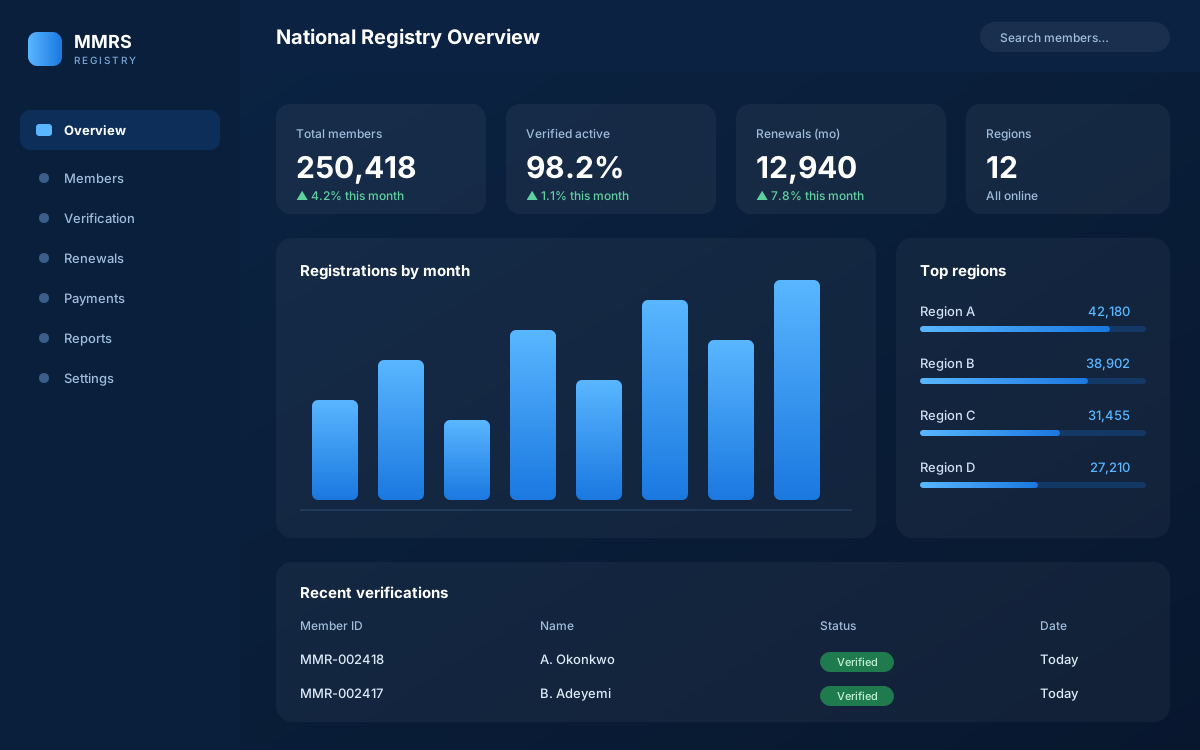
Illustrative interface — not actual client data.
Overview
MMRS is a Member Management & Registry System built to digitize the registration, verification and renewal of members. Sozo delivered the engagement end to end — from operational diagnosis to platform rollout — moving a fragmented, paper-driven process onto a single, auditable system of record.
Challenge
The organizational problem, as it presented itself:
- Member records were spread across paper files and disconnected spreadsheets.
- Verifying a member's status required physically locating documents.
- Manual renewals and payments created backlogs and revenue leakage.
- Leadership had no reliable, current picture of the membership base.
Diagnosis
What we discovered about the underlying system:
- The member lifecycle passed through more than a dozen manual touchpoints, most of which existed to compensate for earlier record failures.
- Several parallel, conflicting spreadsheets were acting as unofficial systems of record.
- Verification demand was external as well as internal — institutions and the public needed to confirm member status, and had no channel.
- Renewal revenue was leaking through untracked manual payment paths.
Intervention
The process and operating model we redesigned — before building anything:
- Redesigned the member lifecycle around a single authoritative record with clear ownership at each stage.
- Replaced compensating checks with role-based approvals at the points where accountability actually mattered.
- Made verification a public, self-service step instead of an internal retrieval task.
- Standardized renewals and receipting into one auditable flow.
Technology
The infrastructure built and integrated to run the redesigned system:
Adoption
How the system was introduced, tested, trained and adopted:
- 1Piloted with one region before wider rollout, migrating records in supervised digitization sprints with dual-verification quality checks.
- 2Trained staff in hands-on cohorts and embedded super-users in each region.
- 3Ran the paper process in parallel for a full renewal cycle before decommissioning it.
Outcome
What changed for the organization:
- A single authoritative registry replaced paper files and parallel spreadsheets.
- Member verification became a self-service check instead of a physical file search.
- Renewals and payments now follow one auditable, receipted flow.
- Leadership works from live registry data rather than reconstructed reports.
Lessons
- Data migration is a change-management project, not a technical one — regional ownership made the difference.
- Public verification created external pressure that accelerated internal adoption.
- Training super-users per region outperformed centralized helpdesk support.
Next phase
Extending the registry with professional development tracking and partner-institution API access — turning the system of record into a system of engagement.
Next case study
NJFP — National Job Fellowship Programme
We don't build software. We build better-functioning organizations.
Your organization may not need another tool. It may need a better system.
If you're dealing with fragmented processes, repetitive work, poor visibility, disconnected data or challenges scaling operations, let's understand the problem before deciding what to build.